
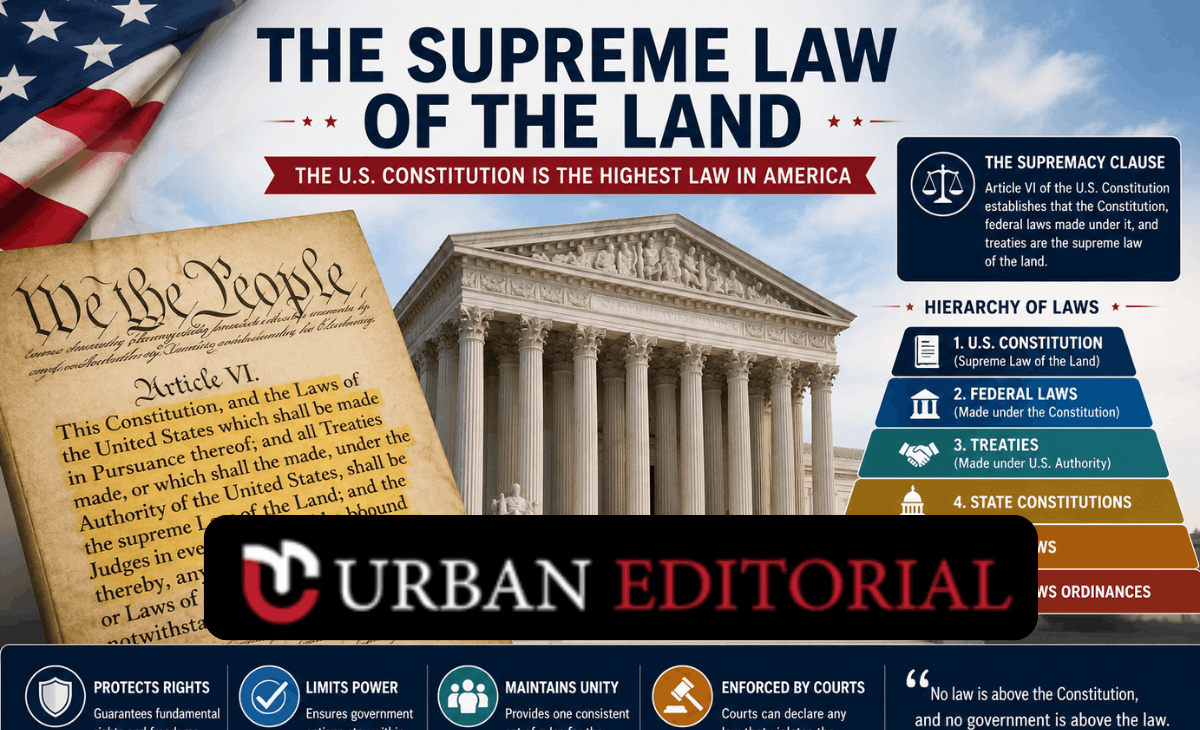

When people ask “what is the supreme law of the land?”, the answer is straightforward: the United States Constitution is the supreme law of the land. This principle is established in Article VI of the Constitution, commonly known as the Supremacy Clause.
Although the answer itself is simple, the concept carries enormous legal and historical significance. The Constitution serves as the foundation of the American legal system, defining the powers of government, protecting individual rights, and ensuring that no federal or state law can override its authority.
This question frequently appears in U.S. civics classes, citizenship tests, and discussions about constitutional law. Yet many people want more than a memorized response—they want to understand why the Constitution holds this position and how it affects everyday life.
In this guide, you’ll learn:
- Why the Constitution is considered the nation’s highest law
- What the Supremacy Clause actually says
- How federal and state laws interact
- Real-world examples of constitutional supremacy
- Common misconceptions surrounding the topic
By the end of this article, you’ll have a practical understanding of why the Constitution remains the legal foundation of the United States more than two centuries after its adoption.
Table of Contents
- What Is the Supreme Law of the Land?
- Understanding the Supremacy Clause
- Why the Constitution Is Called the Supreme Law of the Land
- The History Behind Constitutional Supremacy
- Federal Law vs. State Law
- Real-Life Examples
- Common Misconceptions
- Frequently Asked Questions
- Conclusion
What Is the Supreme Law of the Land?
The answer to what is the supreme law of the land is:
The United States Constitution.
The Constitution is the highest legal authority in the United States. Every branch of government—legislative, executive, and judicial—must operate within the limits established by this document.
No law passed by Congress, no executive order issued by the President, and no state constitution or state law can legally conflict with the Constitution. If a conflict occurs, courts can declare the lower law unconstitutional.
This legal hierarchy helps ensure consistency across the country. While states have broad powers to govern local matters, they cannot enact laws that violate constitutional protections such as freedom of speech, equal protection, or due process.
In practice, the Constitution functions as the nation’s rulebook. It establishes how laws are made, outlines the powers of government, and protects fundamental rights that cannot be taken away without following constitutional procedures.
Why This Principle Matters
Calling the Constitution the “supreme law of the land” is more than symbolic. It has practical consequences for government, courts, and citizens.
For example, if a state passes a law that conflicts with constitutional protections, courts can invalidate that law. This prevents states or government officials from exercising powers beyond those granted by the Constitution.
The principle also creates legal stability. Businesses, courts, lawmakers, and citizens all rely on a common constitutional framework that applies throughout the country.
Where Does This Rule Come From?
The authority comes directly from Article VI of the U.S. Constitution.
Its Supremacy Clause establishes that:
- The Constitution is the highest law.
- Federal laws made under the Constitution have supreme authority.
- Treaties made under U.S. authority are also part of the supreme law.
- State judges must follow the Constitution even when state laws conflict with it.
This clause prevents individual states from ignoring constitutional requirements or creating conflicting legal systems.
Understanding the Supremacy Clause
The Supremacy Clause is one of the Constitution’s most important legal principles. It appears in Article VI, Clause 2 and establishes the order of legal authority in the United States.
Simply put, it means that when federal law is valid under the Constitution, it generally takes precedence over conflicting state law.
However, this does not mean the federal government has unlimited power.
Federal authority is supreme only when it is exercised within the constitutional powers granted by the Constitution. If Congress passes a law beyond those constitutional powers, courts may strike it down.
This balance protects both national unity and the constitutional limits placed on government.
The Legal Hierarchy
Understanding the hierarchy of American law makes the concept easier to grasp.
From highest to lowest authority:
- The United States Constitution
- Federal laws passed under the Constitution
- Treaties made under constitutional authority
- State constitutions
- State laws
- Local ordinances and regulations
Every lower level must remain consistent with the levels above it.
How Courts Apply the Supremacy Clause
Federal and state courts regularly rely on the Supremacy Clause when resolving legal disputes.
Judges ask questions such as:
- Does this law conflict with the Constitution?
- Is Congress acting within its constitutional authority?
- Does federal law override conflicting state legislation?
If the answer shows a constitutional conflict, the Constitution prevails.
This judicial review helps maintain constitutional order across all fifty states.
Why the Constitution Is Called the Supreme Law of the Land
The Constitution holds this title because it is the legal foundation upon which every other American law is built.
Unlike ordinary legislation, the Constitution cannot be changed through a simple vote in Congress. Instead, amendments require an intentionally rigorous process involving both Congress and the states. This higher standard reflects the Constitution’s unique role as the nation’s governing framework.
The Constitution performs several essential functions:
It Creates the Federal Government
Rather than granting unlimited authority, the Constitution establishes specific powers for each branch of government.
This separation of powers helps prevent any one branch from becoming too powerful.
It Protects Individual Rights
Many of America’s most important freedoms originate from the Constitution, including:
- Freedom of speech
- Freedom of religion
- Freedom of the press
- Right to due process
- Equal protection under the law
- Protection against unreasonable searches
These protections apply nationwide and often limit the actions of both federal and state governments.
It Limits Government Power
A common misconception is that the Constitution mainly grants government authority.
In reality, it also limits that authority.
Government officials cannot simply create laws that violate constitutional rights, even if those laws receive widespread political support.
This system protects minorities, individuals, and future generations from arbitrary government action.
It Provides Stability
The Constitution has remained in effect since 1789, making it one of the world’s oldest written national constitutions still in operation.
Although amended over time, its core structure has provided remarkable continuity through wars, economic crises, political change, and technological advancement.
Its endurance reflects a balance between stability and adaptability, allowing the nation to evolve while maintaining a consistent constitutional framework.
Key Takeaways
- The answer to what is the supreme law of the land is the United States Constitution.
- The principle is established in Article VI’s Supremacy Clause.
- No federal or state law may conflict with the Constitution.
- Courts play a vital role in enforcing constitutional supremacy.
- The Constitution establishes government powers, protects individual rights, and provides the legal foundation for every other law in the United States.
The History Behind Constitutional Supremacy
Understanding what is the supreme law of the land becomes much easier when you explore how the United States Constitution came to hold this position. The principle did not emerge overnight. Instead, it developed through years of political debate, practical experience, and a desire to create a stronger, more unified nation.
From the Articles of Confederation to the Constitution
Before the Constitution, the United States operated under the Articles of Confederation, adopted in 1781. While the Articles helped unify the states after independence, they created a weak national government with limited powers.
Some of the biggest challenges included:
- Congress could not effectively collect taxes.
- States often created conflicting laws and trade policies.
- The national government struggled to enforce its decisions.
- There was no strong executive branch to carry out federal laws.
- There was no national judicial system to resolve disputes between states.
As these weaknesses became increasingly apparent, many leaders concluded that the country needed a stronger constitutional framework.
The Constitutional Convention of 1787
In May 1787, delegates from twelve states gathered in Philadelphia to revise the Articles of Confederation. Instead of making minor changes, they drafted an entirely new Constitution.
Their goals included:
- Creating a stronger federal government.
- Protecting individual liberty.
- Preventing abuses of power.
- Establishing a system of checks and balances.
- Ensuring that national laws could be applied consistently across all states.
One of the most significant outcomes was the inclusion of the Supremacy Clause in Article VI, making the Constitution the nation’s highest legal authority.
A Brief Timeline of Constitutional Supremacy
Understanding key historical milestones helps explain why constitutional supremacy remains central to American government.
| Year | Event | Significance |
| 1776 | Declaration of Independence | American colonies declare independence from Britain. |
| 1781 | Articles of Confederation take effect | First national government with limited authority. |
| 1787 | Constitutional Convention | Delegates draft the U.S. Constitution. |
| 1788 | Constitution ratified | Required states approve the new framework. |
| 1789 | Constitution becomes effective | New federal government begins operating. |
| 1791 | Bill of Rights adopted | First ten amendments protect individual freedoms. |
| 1803 | Marbury v. Madison | Supreme Court establishes judicial review. |
| 1868 | Fourteenth Amendment | Strengthens constitutional protections and equal protection under the law. |
This timeline demonstrates that constitutional supremacy has evolved through both constitutional amendments and landmark court decisions.
How Federal and State Laws Work Together
One of the most common questions people ask after learning what is the supreme law of the land is whether federal law always overrides state law.
The answer is not always.
The Constitution divides governmental authority between the federal government and the states. This system is known as federalism.
Federalism allows states to govern many local matters while giving the national government authority over issues affecting the entire country.
Examples of state responsibilities include:
- Public education
- Driver licensing
- Property law
- Local policing
- Marriage procedures
- State taxation
Federal responsibilities include:
- National defense
- Immigration
- International treaties
- Interstate commerce
- Currency
- Foreign policy
Most of the time, both systems operate without conflict.
When Does Federal Law Override State Law?
Federal law takes priority only when:
- Congress acts within its constitutional authority.
- A federal law directly conflicts with state law.
- The Constitution specifically grants authority to the federal government.
If these conditions are met, the conflicting state law cannot be enforced.
However, if Congress exceeds its constitutional powers, federal courts may declare the federal law unconstitutional.
This demonstrates that the Constitution—not simply the federal government—is the true supreme law of the land.
Real-Life Examples of Constitutional Supremacy
Legal principles become easier to understand through practical examples.
Example 1: Freedom of Speech
Imagine a state passes a law making it illegal to criticize government officials online.
The First Amendment protects freedom of speech.
Because the Constitution has higher authority than state law, courts would likely strike down that state law as unconstitutional.
Example 2: Religious Freedom
Suppose a city requires every resident to attend services at one particular church.
The Constitution protects religious freedom and prohibits government establishment of religion.
Such a law would violate constitutional rights and could not remain in force.
Example 3: Equal Protection
If a state created a law denying certain citizens equal access to public services based solely on race, courts would evaluate that law under the Fourteenth Amendment.
Because constitutional protections override conflicting state laws, discriminatory legislation can be invalidated.
Example 4: Voting Rights
Federal constitutional amendments prohibit discrimination in voting based on race, sex, or age (for citizens 18 and older).
If a state adopted rules that violated these constitutional guarantees, federal courts could require the state to change them.
Landmark Supreme Court Decisions
Several Supreme Court cases have reinforced constitutional supremacy throughout American history.
Marbury v. Madison (1803)
Perhaps the most influential constitutional decision, Marbury v. Madison established the principle of judicial review.
Judicial review gives courts the authority to determine whether laws violate the Constitution.
Without this power, constitutional supremacy would be much harder to enforce.
McCulloch v. Maryland (1819)
This case confirmed that states cannot interfere with valid exercises of federal constitutional authority.
It reinforced the principle that constitutional federal powers are superior to conflicting state actions.
Brown v. Board of Education (1954)
The Supreme Court ruled that racial segregation in public schools violated the Constitution’s Equal Protection Clause.
The decision demonstrated that constitutional rights apply even when state laws say otherwise.
Common Misconceptions
Despite its importance, constitutional supremacy is often misunderstood.
Misconception 1: Federal Government Can Do Anything
Reality: Federal authority is limited by the Constitution.
Congress cannot simply pass any law it wants.
Misconception 2: States Have No Rights
Reality: States retain many powers under the Tenth Amendment.
Only certain powers belong exclusively to the federal government.
Misconception 3: The Supreme Court Creates the Constitution
Reality: The Supreme Court interprets the Constitution.
It does not rewrite or replace it.
Misconception 4: Every Federal Law Automatically Overrides State Law
Reality: Only constitutional federal laws take precedence.
If a federal law exceeds constitutional authority, courts may invalidate it.
Expert Insight
Constitutional scholars often describe the Constitution as both a grant of power and a limitation on power.
Its importance lies not only in creating government institutions but also in establishing boundaries that protect liberty.
Legal experts emphasize that constitutional supremacy promotes:
- Equal application of law.
- Stability across all fifty states.
- Protection of civil liberties.
- Predictable legal outcomes.
- Peaceful resolution of governmental disputes.
Rather than concentrating power in one institution, the Constitution distributes authority among the legislative, executive, and judicial branches while reserving additional powers to the states and the people.
Interesting Facts
- The U.S. Constitution is one of the oldest written national constitutions still in active use.
- It originally contained seven articles.
- The Bill of Rights added the first ten amendments in 1791.
- The Constitution has been amended 27 times.
- Every federal and state official takes an oath to support the Constitution—not a president, political party, or government agency.
- The Supremacy Clause appears in Article VI, near the end of the original Constitution, yet it remains one of its most influential provisions.
Key Takeaways
- The Constitution became the supreme law of the land after replacing the Articles of Confederation.
- The Supremacy Clause ensures constitutional authority over conflicting state laws.
- Federalism allows both federal and state governments to share power within constitutional limits.
- Landmark Supreme Court decisions have strengthened and clarified constitutional supremacy.
- Understanding these principles helps explain how the U.S. legal system maintains consistency while protecting individual rights.
Frequently Asked Questions
What is the supreme law of the land?
The supreme law of the land is the United States Constitution. This principle is established in Article VI, known as the Supremacy Clause, which makes the Constitution the highest legal authority in the nation.
Where does the phrase come from?
The phrase comes from Article VI, Clause 2 of the Constitution. The clause states that the Constitution, federal laws made under it, and treaties made under U.S. authority are the supreme Law of the Land.
Does federal law always override state law?
No. Federal law overrides state law only when the federal law is constitutional and Congress is acting within its constitutional powers. If a federal law exceeds those powers, courts may declare it unconstitutional.
Why is the Constitution considered supreme?
The Constitution is supreme because it creates the federal government, defines its powers, protects individual rights, and establishes limits on governmental authority. Every other law must conform to it.
Who enforces the Constitution?
All branches of government help enforce the Constitution, but courts—especially the U.S. Supreme Court—play a central role through judicial review, which allows judges to determine whether laws violate the Constitution.
Can the Constitution be changed?
Yes. The Constitution can be amended through the process described in Article V. Amendments require approval by Congress and the states, making changes intentionally difficult.
Is the Bill of Rights part of the supreme law of the land?
Yes. The Bill of Rights consists of the first ten amendments to the Constitution, so it carries the same constitutional authority as the rest of the document.
Why is this question common on the U.S. citizenship test?
The question “What is the supreme law of the land?” appears on the U.S. civics test because understanding the Constitution is considered a basic requirement of civic knowledge and democratic participation.
Conclusion
If you remember only one thing from this guide, remember this: the United States Constitution is the supreme law of the land.
This principle is not merely a phrase memorized for a civics exam. It is the foundation of the American legal system. The Constitution establishes the structure of government, protects individual rights, limits governmental power, and provides a common legal framework for all fifty states.
Through the Supremacy Clause, the Constitution ensures that no conflicting state law, federal statute, or government action can stand above it. Courts, lawmakers, and public officials must all operate within its boundaries.
Understanding what is the supreme law of the land helps citizens understand how rights are protected, how disputes between governments are resolved, and why the Constitution remains one of the most influential legal documents in the world.
More than two centuries after it took effect, the Constitution continues to shape American government and public life every day.