
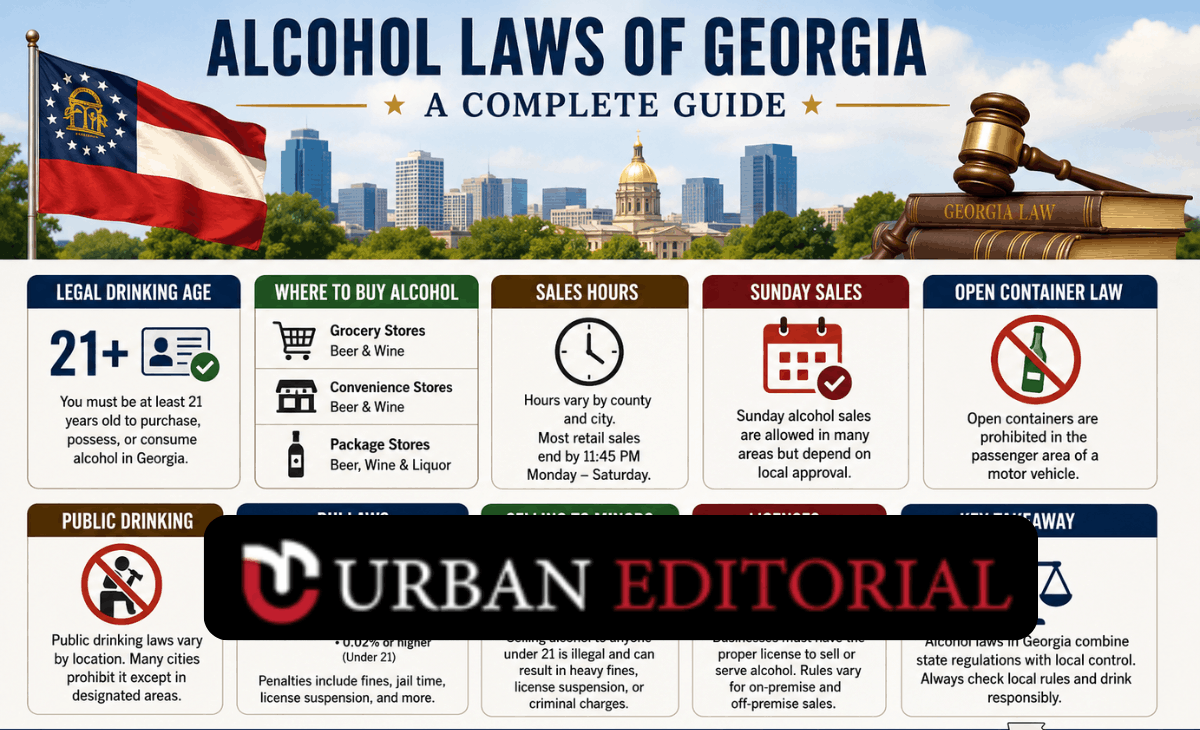

Whether you’re a Georgia resident, a tourist, a business owner, or simply curious about state regulations, understanding the alcohol laws of Georgia is essential. Georgia has modernized many of its alcohol regulations over the years, but the rules can still vary depending on the city or county. Knowing what is legal—and what is not—can help you avoid fines, legal trouble, or confusion when purchasing or consuming alcoholic beverages.
Georgia allows adults aged 21 and older to buy and consume alcohol, but there are detailed rules covering where alcohol can be sold, when stores can operate, who may serve alcohol, and how local governments regulate sales. In addition, strict penalties apply to underage drinking, driving under the influence, and selling alcohol without the appropriate license.
This guide explains Georgia’s alcohol laws in plain language. It covers purchasing rules, drinking age requirements, sales hours, local regulations, DUI laws, licensing, and recent changes that affect residents and visitors alike.
Table of Contents
- Understanding Alcohol Laws in Georgia
- Legal Drinking Age in Georgia
- Where Alcohol Can Be Purchased
- Types of Alcohol Sales and Licensing
- Sales Hours Across Georgia
- Sunday Alcohol Sales Explained
- Open Container and Public Drinking Laws
- DUI and Driving Laws
- Local County and City Regulations
- Frequently Asked Questions
- Conclusion
Understanding Alcohol Laws in Georgia
Georgia regulates alcohol through a combination of state laws and local government authority. While the state establishes general rules, counties and municipalities have significant control over how alcohol is sold within their jurisdictions. This local flexibility means that the experience of buying alcohol may differ from one community to another.
The state’s alcohol regulations are designed to balance public safety with consumer convenience. They govern who can purchase alcohol, who may sell it, the hours during which sales are permitted, licensing requirements for businesses, and enforcement measures against illegal sales or consumption.
Georgia recognizes several categories of alcoholic beverages, including:
- Beer
- Wine
- Distilled spirits (liquor)
- Malt beverages
- Ready-to-drink alcoholic beverages
Each category may be subject to different licensing requirements depending on whether the alcohol is sold for on-premises consumption, such as at a restaurant or bar, or for off-premises consumption, such as at a grocery or package store.
One of the most important aspects of Georgia’s system is local control. A county may authorize Sunday sales while a neighboring county may choose different operating hours or impose additional restrictions. As a result, checking local regulations before purchasing alcohol is always a good idea.
Legal Drinking Age in Georgia
Like every U.S. state, Georgia sets the legal drinking age at 21 years old. Anyone under the age of 21 is generally prohibited from purchasing, possessing, or consuming alcoholic beverages except in limited circumstances recognized by law.
Businesses are required to verify a customer’s age before completing an alcohol sale. Acceptable forms of identification typically include:
- Driver’s license
- State-issued identification card
- Military identification
- Passport
Retailers that fail to verify age can face significant penalties, including fines, suspension of alcohol licenses, or permanent license revocation.
Underage Possession
Possessing alcohol while under the legal age can lead to legal consequences that may include:
- Monetary fines
- Community service
- Alcohol education programs
- Driver’s license suspension in certain situations
- Criminal charges depending on the circumstances
These penalties are intended to discourage underage drinking and promote responsible alcohol use.
Fake Identification
Using a fake ID to purchase alcohol is a serious offense in Georgia. Individuals caught using fraudulent identification may face criminal charges, fines, and additional penalties affecting driving privileges.
Businesses that knowingly accept fake identification or sell alcohol to minors may also face disciplinary action from state regulators.
Where Alcohol Can Be Purchased
Georgia offers several options for purchasing alcoholic beverages, although availability depends on both state law and local ordinances.
Grocery Stores
Many grocery stores sell beer and wine. This provides consumers with convenient access while shopping for everyday household items.
However, distilled spirits are generally not sold in standard grocery stores.
Convenience Stores
Convenience stores commonly offer beer and malt beverages. Some locations also sell wine where permitted by local regulations.
Store owners must maintain valid alcohol licenses and comply with all age verification requirements.
Package Stores
Liquor purchases are generally made through licensed package stores. These businesses specialize in selling distilled spirits and often carry an extensive selection of:
- Whiskey
- Vodka
- Rum
- Gin
- Tequila
- Brandy
- Specialty liqueurs
Package stores operate under licensing rules that differ from grocery retailers.
Restaurants and Bars
Licensed restaurants, hotels, breweries, wineries, and bars may serve alcoholic beverages for on-premises consumption.
Customers must generally be at least 21 years old to purchase alcoholic drinks. Staff members are trained to identify intoxicated patrons and refuse service when necessary.
Types of Alcohol Sales and Licensing
Georgia regulates alcohol sales through a licensing system that helps ensure responsible business practices and public safety. Businesses cannot legally sell alcoholic beverages without obtaining the appropriate permits.
Different licenses exist depending on the nature of the business.
On-Premises Sales
These licenses allow customers to consume alcohol where it is purchased.
Examples include:
- Restaurants
- Bars
- Hotels
- Country clubs
- Entertainment venues
- Breweries with tasting rooms
- Wineries
Businesses serving alcohol must comply with responsible beverage service requirements and may be inspected by regulatory authorities.
Off-Premises Sales
These licenses allow alcohol to be purchased for consumption elsewhere.
Examples include:
- Grocery stores
- Convenience stores
- Package stores
- Specialty beverage retailers
Retailers must follow strict rules regarding sales hours, identification checks, product storage, and recordkeeping.
Special Event Permits
Organizations hosting festivals, charity events, concerts, or community gatherings often need temporary alcohol permits. These permits help ensure alcohol is served responsibly during limited-time events.
Applicants generally must meet eligibility requirements and comply with local government regulations before receiving approval.
Licensing Compliance
Licensed businesses are expected to maintain ongoing compliance with state regulations. Common violations include:
- Selling alcohol to minors
- Selling outside authorized hours
- Operating without a valid license
- Serving visibly intoxicated customers
- Failing to maintain required records
Regulatory agencies may issue fines, suspend licenses, or revoke operating privileges for serious or repeated violations.
Key Takeaways
- Georgia’s alcohol laws combine statewide regulations with local county and city authority.
- The legal drinking age is 21.
- Grocery stores typically sell beer and wine, while liquor is sold through licensed package stores.
- Businesses must obtain the correct alcohol licenses before selling alcoholic beverages.
- Strict penalties apply for underage sales, fake identification, and licensing violations.
Alcohol Sales Hours in Georgia
One of the most common questions about the alcohol laws of Georgia is when alcohol can legally be purchased. While Georgia sets statewide guidelines, local governments have the authority to establish their own operating hours within those limits. As a result, the exact hours may vary depending on where you are in the state.
Most licensed retailers display their permitted sales hours at the entrance or near the checkout area. If you’re visiting a different county or city, it’s always wise to verify local rules before making a purchase.
Retail Sales Hours
Retail alcohol sales generally follow approved business hours established by state law and local ordinances. Grocery stores, convenience stores, and package stores must stop selling alcohol once their authorized sales period ends.
Some municipalities permit extended evening sales, while others choose earlier closing times to reduce noise and public safety concerns.
Consumers should remember that purchasing alcohol outside approved hours is not allowed, even if the business remains open for other products.
Restaurant and Bar Service Hours
Restaurants and bars often have different operating rules than retail stores because alcohol is consumed on the premises.
Licensed establishments may serve beer, wine, and spirits during approved service hours. However, staff must stop serving alcohol once legal service hours end, regardless of whether customers remain inside the establishment.
Businesses that violate these rules risk fines, suspension of their alcohol license, or other enforcement actions.
Why Hours Vary
Georgia gives counties and cities flexibility to regulate alcohol sales based on local needs. Factors influencing local decisions include:
- Population size
- Tourism activity
- Community preferences
- Public safety concerns
- Local elections regarding alcohol sales
Because of this local control, neighboring communities may have different alcohol sales schedules.
Sunday Alcohol Sales Explained
Sunday alcohol sales have changed significantly in Georgia over the past decade. Previously, many areas prohibited Sunday sales altogether. Legislative changes now allow local governments to authorize Sunday sales if approved through the required local process.
Today, many counties and cities permit Sunday sales, while others continue to maintain restrictions.
How Local Approval Works
Rather than imposing one statewide rule, Georgia allows local governments to decide whether businesses may sell alcohol on Sundays.
If local officials approve Sunday sales, licensed businesses may operate during the authorized hours established for that community.
This means travelers may notice different rules when crossing county or city boundaries.
Restaurants on Sundays
Restaurants in many areas are allowed to serve alcoholic beverages with meals on Sundays, provided they hold the appropriate license and comply with local regulations.
Brunch service has become particularly popular in communities that permit Sunday alcohol sales.
Retail Stores on Sundays
Many grocery stores and package stores also participate in Sunday sales where local law permits.
However, not every jurisdiction has adopted identical rules. Consumers should check local ordinances if they are unfamiliar with the area.
Open Container and Public Drinking Laws
Understanding where alcohol may legally be consumed is just as important as knowing where it can be purchased.
Georgia has clear laws regarding open containers, public drinking, and alcohol possession inside vehicles.
Open Containers in Vehicles
Georgia prohibits drivers from possessing an open container of alcohol within the passenger area of a motor vehicle while operating on public roads.
This law is intended to reduce impaired driving and improve roadway safety.
An open container generally refers to a bottle, can, or other alcoholic beverage container that has been opened, has a broken seal, or has partially removed contents.
Violating the open container law may result in fines and additional legal consequences.
Public Consumption
Public drinking is not automatically legal throughout Georgia.
Whether alcohol may be consumed in public depends on local ordinances and the specific location.
Examples where restrictions commonly apply include:
- Public streets
- Sidewalks
- Government buildings
- Public parks
- Parking lots
- Public transportation
Some cities designate entertainment districts where open containers are permitted under specific conditions. Outside these designated areas, consuming alcohol in public may lead to citations or fines.
Special Events
Festivals, sporting events, and concerts may receive temporary permits allowing alcohol service within controlled event areas.
Visitors should remain inside designated boundaries when consuming alcoholic beverages during these events.
Driving Under the Influence (DUI) Laws
Georgia enforces strict impaired driving laws, and DUI offenses carry serious penalties. The state considers driving under the influence one of its most significant public safety concerns.
Law enforcement officers may investigate suspected impairment through field sobriety testing, chemical testing, and other legally authorized procedures.
Blood Alcohol Concentration (BAC) Limits
Georgia uses different BAC thresholds depending on the driver’s age and license type.
Common legal standards include:
- Drivers age 21 and older
- Commercial driver’s license holders
- Drivers under age 21
Commercial drivers and individuals under the legal drinking age are subject to stricter limits than most adult drivers.
Importantly, a driver may still be charged with DUI if alcohol or drugs impair safe driving, even if their BAC is below the standard legal threshold.
Penalties for DUI
A DUI conviction can have lasting consequences beyond fines.
Potential penalties include:
- License suspension
- Significant financial penalties
- Jail time
- Mandatory alcohol education
- Community service
- Probation
- Installation of an ignition interlock device in certain cases
- Increased insurance costs
Repeat offenses generally result in more severe penalties.
Refusing Chemical Testing
Georgia’s implied consent laws require drivers arrested for suspected DUI to submit to certain chemical testing procedures.
Refusing an authorized chemical test may lead to administrative consequences, including driver’s license suspension, separate from any criminal DUI case.
Penalties for Alcohol-Related Violations
Georgia imposes penalties not only for impaired driving but also for various alcohol-related offenses involving businesses and individuals.
Selling Alcohol to Minors
Businesses that sell alcohol to someone under 21 may face:
- Financial penalties
- License suspension
- License revocation
- Criminal charges in serious cases
Employees responsible for illegal sales may also be personally liable.
Purchasing Alcohol for Minors
Adults who knowingly purchase alcohol for underage individuals may face criminal penalties.
This rule applies even when no money changes hands.
False Identification
Using or producing fake identification to obtain alcohol may result in:
- Criminal charges
- Court appearances
- Driver’s license consequences
- Financial penalties
Disorderly Conduct
Alcohol-related misconduct, including public intoxication combined with disruptive behavior, may lead to arrest depending on the circumstances.
Law enforcement officers evaluate each situation based on applicable state and local laws.
Recent Developments and Practical Considerations
Georgia’s alcohol laws continue to evolve as consumer preferences and business practices change.
Recent years have seen expanded convenience for consumers through broader Sunday sales in many communities and continued growth in local breweries, wineries, and distilleries.
However, local governments still retain substantial authority over:
- Sales hours
- Licensing
- Entertainment districts
- Special event permits
- Local enforcement priorities
This combination of statewide standards and local flexibility means residents should stay informed about the rules in their specific county or municipality.
Practical Example
Imagine a traveler driving through several Georgia counties over a holiday weekend.
One county may allow Sunday package store sales beginning in the morning, while another nearby county may have different authorized hours or additional restrictions. Similarly, one downtown entertainment district may permit open containers within marked boundaries, while another city prohibits public drinking altogether.
Understanding these local differences helps travelers avoid accidental violations while enjoying their visit.
Local County and City Variations
One of the most distinctive features of Georgia’s alcohol regulations is the level of authority given to local governments. Although the state establishes the overall legal framework, counties and municipalities can make important decisions about how alcohol is sold and served within their boundaries.
This local control means that alcohol laws may differ from one community to another. For example, one county may allow extended sales hours or Sunday package sales, while a neighboring county may have more restrictive rules. Businesses operating in multiple locations must comply with both state requirements and local ordinances.
Before purchasing or serving alcohol in an unfamiliar area, it’s a good idea to confirm the local rules. This is especially important for travelers, event organizers, and business owners.
Examples of Local Differences
Local governments may regulate:
- Sunday alcohol sales
- Operating hours for retailers
- Restaurant and bar service hours
- Special event permits
- Entertainment districts
- Local licensing requirements
- Zoning restrictions for alcohol retailers
These variations reflect community preferences while still operating within Georgia’s statewide legal framework.
Alcohol Delivery and Online Sales
Consumer shopping habits have changed significantly in recent years, and alcohol retailers have adapted by offering delivery and online ordering where permitted.
Licensed businesses may allow customers to order beer, wine, or spirits online for pickup or delivery, provided they comply with Georgia law and local regulations.
Age Verification Remains Essential
Whether alcohol is purchased in person or online, verifying the buyer’s age remains a legal requirement.
Delivery drivers are generally expected to:
- Check a valid government-issued photo ID
- Confirm the recipient is at least 21 years old
- Refuse delivery if identification cannot be verified
- Avoid leaving alcohol unattended
These safeguards help prevent underage access and ensure responsible sales practices.
Business Responsibilities
Retailers offering delivery services should have clear policies regarding:
- Customer identification
- Delivery procedures
- Employee training
- Recordkeeping
- Compliance with licensing conditions
Failure to follow these requirements may result in fines or licensing actions.
Common Misconceptions About Georgia Alcohol Laws
Many people misunderstand how Georgia’s alcohol laws work. Clearing up these misconceptions can help residents and visitors avoid unnecessary confusion.
Alcohol Laws Are the Same Everywhere in Georgia
Reality: Local governments have authority over several aspects of alcohol regulation, including sales hours and Sunday sales.
Grocery Stores Sell Every Type of Alcohol
Reality: Grocery stores commonly sell beer and wine, but distilled spirits are generally sold through licensed package stores.
Having One Drink Means You Can Always Drive Legally
Reality: Alcohol affects everyone differently. Factors such as body weight, food intake, and metabolism influence impairment. A person may be unsafe to drive even after consuming a small amount of alcohol.
Fake IDs Only Affect the Person Using Them
Reality: Businesses that knowingly sell alcohol to someone using fraudulent identification may also face significant penalties.
Public Drinking Is Allowed Everywhere
Reality: Public alcohol consumption depends on local ordinances. Some cities permit it only within designated entertainment districts, while many public places prohibit it entirely.
Pros and Cons of Georgia’s Alcohol Laws
Like any regulatory system, Georgia’s alcohol laws have advantages and challenges.
Pros
- Promotes responsible alcohol sales through licensing.
- Helps reduce underage drinking.
- Provides local communities with flexibility.
- Supports public safety through DUI enforcement.
- Allows consumers access through grocery stores, restaurants, and licensed retailers.
- Encourages responsible business practices through inspections and compliance requirements.
Cons
- Rules can differ significantly between counties.
- Visitors may find local regulations confusing.
- Businesses operating in multiple jurisdictions must monitor different local requirements.
- Consumers may need to research local ordinances before purchasing alcohol.
- Licensing compliance can be complex for new business owners.
Expert Insights
From a legal and public policy perspective, Georgia’s approach reflects a balance between statewide consistency and local decision-making.
Allowing counties and municipalities to regulate certain aspects of alcohol sales gives communities the flexibility to address their unique needs while maintaining statewide standards for licensing, underage drinking prevention, and impaired driving.
For consumers, the most practical approach is to stay informed about local rules rather than assuming every jurisdiction follows identical regulations.
Business owners should also invest in employee training, particularly regarding age verification and responsible alcohol service. Proper compliance not only reduces legal risks but also strengthens customer trust and protects the business’s reputation.
Interesting Facts
- Georgia combines state regulation with significant local control over alcohol sales.
- Restaurants, breweries, wineries, and package stores each operate under different licensing categories.
- Sunday alcohol sales were expanded through changes that allow local communities to decide whether to permit them.
- Georgia has strict penalties for selling alcohol to minors.
- Alcohol licensing plays an important role in supporting responsible retail operations across the state.
Key Takeaways
Understanding the alcohol laws of Georgia is important for residents, visitors, and business owners alike. While the state establishes the overall legal framework, many practical rules depend on local government decisions.
Here are the main points to remember:
- The legal drinking age is 21.
- Beer and wine are commonly available in grocery stores.
- Distilled spirits are generally sold through licensed package stores.
- Alcohol sales hours vary by local jurisdiction.
- Sunday sales depend on local approval.
- Driving under the influence carries severe legal penalties.
- Open container rules apply inside motor vehicles.
- Public drinking is governed by local ordinances.
- Businesses must obtain appropriate licenses before selling alcohol.
- Age verification is required for every alcohol purchase.
Frequently Asked Questions
1. What is the legal drinking age in Georgia?
The legal age to purchase and consume alcoholic beverages in Georgia is 21 years old.
2. Can grocery stores sell liquor in Georgia?
No. Grocery stores generally sell beer and wine, while distilled spirits are typically sold through licensed package stores.
3. Are Sunday alcohol sales legal?
Yes, in many communities. However, Sunday sales depend on local government approval, so rules vary by county and city.
4. Can passengers have an open container in a vehicle?
Georgia’s open container laws restrict open alcoholic beverages within the passenger area of a motor vehicle. Certain exceptions may apply depending on the type of vehicle and applicable law.
5. Is public drinking allowed?
Not everywhere. Public alcohol consumption depends on local ordinances and whether a city has designated entertainment districts or other permitted areas.
6. Can alcohol be delivered to my home?
Yes, licensed retailers may offer alcohol delivery where permitted, but the recipient must be at least 21 years old and present valid identification upon delivery.
7. What happens if a business sells alcohol to a minor?
Businesses may face fines, license suspension, license revocation, and other legal penalties. Employees involved in illegal sales may also face consequences.
8. Why do alcohol rules differ between counties?
Georgia law allows local governments to regulate certain aspects of alcohol sales, giving communities flexibility to adopt rules that meet local needs.
Conclusion
Understanding the Alcohol Laws of Georgia helps consumers make informed decisions and encourages responsible alcohol use. Although the state provides a clear legal framework, local governments play an important role in determining sales hours, Sunday operations, and other community-specific regulations.
Whether you’re purchasing alcohol for a family gathering, visiting Georgia on vacation, or operating a licensed business, staying informed about current state and local requirements is the best way to remain compliant. By respecting age restrictions, following DUI laws, and understanding local regulations, residents and visitors alike can enjoy alcoholic beverages responsibly while avoiding unnecessary legal issues.