
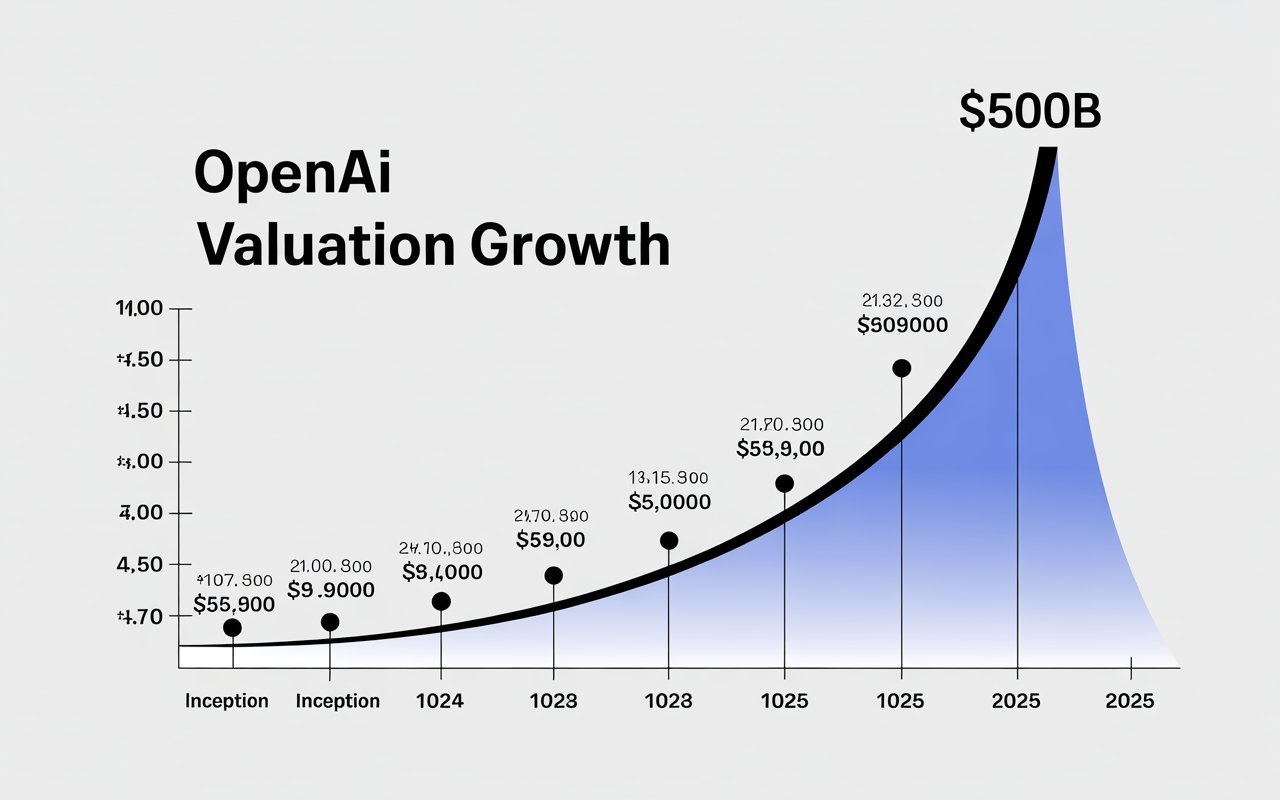

The openai valuation story is one of the most remarkable in modern tech — a company evolving from nonprofit roots into a powerhouse valued in the hundreds of billions of dollars. From early VC rounds to major secondary market transactions in 2025, the valuation trajectory highlights investor confidence in AI’s long-term economic impact. This article breaks down that journey with real figures, key funding events, revenue context, and what this means for the future of AI businesses.
What Does “OpenAI Valuation” Actually Mean?
In business terms, valuation refers to how much investors believe a company is worth at a given moment — often based on funding rounds, revenue growth, market potential, and competitive positioning.
For private companies like OpenAI, valuation mostly comes through:
- Primary funding rounds (new capital into the company)
- Secondary share sales (existing shares sold to new investors)
Each of these impacts the reported valuation, and for OpenAI, both have led to huge jumps in just a few years.
Early Valuation Milestones
OpenAI’s valuation began modestly in its early years, especially considering its unique hybrid structure (a for-profit arm governed by a nonprofit board). Notable milestones include:
- 2024: After a $6.6 billion funding round in October 2024, OpenAI was valued at around $157 billion — a massive leap from earlier years.
- March 2025: The company raised approximately $40 billion at a $300 billion valuation in one of the biggest funding rounds in tech history.
These rounds reflected growing adoption of GPT-4 and enterprise AI services, alongside strong backing from major investors.
The 2025 Leap: Half-Trillion Dollar Valuation
The most headline-grabbing moment came in 2025, when OpenAI’s valuation hit $500 billion following a secondary share sale. This event allowed current and former employees to sell around $6.6 billion worth of shares to a consortium of investors.
Key Takeaways:
- Secondary sales don’t inject new cash into the company — they provide liquidity to stakeholders.
- Despite not yet being a public company, OpenAI’s private valuation surpassed $500B, making it one of the most valuable startups globally.
This valuation jump also placed the company ahead of rivals like SpaceX at the time, highlighting how AI has become a priority for global capital markets.
Valuation Drivers: Why Investors Bet Big
So what is driving this openai valuation boom?
Massive User Adoption
OpenAI’s flagship product, ChatGPT, reached hundreds of millions of weekly users within a short span, dwarfing the user growth curves of many tech giants at similar stages.
Enterprise & Developer Demand
Businesses are increasingly integrating OpenAI’s APIs and enterprise tools, contributing to recurring revenue streams.
Strategic Partnerships
Investments from major tech firms signal confidence in OpenAI’s market position — not just in language models, but in broader AI infrastructure and services.
Discover exclusive content from Urbaneditorial
Real-World Example: Secondary Share Sales and Valuation
A defining real case in support of openai valuation comes from October 2025:
Employee Share Sale at $500B Valuation
Employees sold $6.6 billion worth of shares, enabling liquidity for early engineers and contributors while cementing OpenAI’s valuation among private companies.
This kind of share sale — while not a traditional funding round — influences market perception about valuation, as it reflects what investors are willing to pay to own shares right now.
From Valuation to Revenue: Is It Profitable?
Despite its astronomical openai valuation, OpenAI has historically prioritized growth over profitability — a common trend in high-growth tech sectors. While significant revenue growth is evident, the company has not publicly disclosed consistent net profitability. This is typical for companies focused on scaling and R&D investments at this stage.
What About Future Valuation Claims?
There are ongoing reports and speculation about future funding rounds that could push OpenAI’s valuation even higher — possibly into the $700B+ range. Some private market chatter even suggests ambitions approaching $830 billion in late 2025.
IPO Prospects and What It Means for Valuation
An eventual IPO could anchor OpenAI’s valuation in public market metrics (like revenue multiples and profit margins), offering a benchmark instead of private transactions. While no official timeline has been confirmed, conversations about potential IPOs around 2026–2027 suggest this could be on the horizon — with valuation implications that may either validate or adjust current estimates.
Risks and Valuation Concerns
Rapid valuation increase doesn’t guarantee future success. Some analysts caution against overly optimistic valuations without clear profitability paths — especially given intense competition in generative AI and regulatory scrutiny. In markets like this, valuations can fluctuate if growth slows or investment sentiment changes.
Summary: OpenAI Valuation in Context
To recap the openai valuation journey:
- Early rounds placed OpenAI in the tens of billions.
- 2025 funding rounds raised valuation to $300B.
- Secondary sales pushed it to an estimated $500B.
- Future rounds might reach even higher valuations.
This trajectory reflects both the power of AI adoption and the confidence investors place in OpenAI’s future role in global technology.
FAQs
- What is OpenAI’s current valuation?
As of late 2025, OpenAI’s valuation is widely reported at around $500 billion. - Has OpenAI ever raised funding at other valuations?
Yes — in March 2025, a $40B round valued OpenAI at $300B. - Is OpenAI profitable?
OpenAI is generating substantial revenue but has not publicly reported consistent net profits, focusing instead on growth. - Could OpenAI valuation reach $1 trillion?
Some reports speculate future rounds could push valuation beyond $700B–$800B, though these are not yet confirmed. - When might OpenAI go public?
There’s industry speculation about a possible IPO around 2026–2027, but no official date is set.
Conclusion
The openai valuation story is more than just big numbers — it’s about how the AI revolution is reshaping how investors value technology companies. OpenAI’s rapid rise from nonprofit beginnings to a potential half-trillion-dollar valuation highlights explosive demand for AI capabilities, strong funding support, and strategic partnerships. As it moves closer to possible IPO discussions, understanding valuation helps paint a picture of where AI fits in both the tech world and the broader economy.